DeepSeek-V4-Flash RL on AMD MI355X with verl: 300 Stable Steps and FP8 Rollout Alignment
verl runs DeepSeek-V4-Flash GRPO on 32 AMD Instinct MI355X GPUs: training aligned with FP8 rollout quantization, and BF16, BF16+QAT and FP8 recipes each completed 300 stable steps.
verl now runs DeepSeek-V4-Flash reinforcement learning on AMD Instinct™ MI355X GPUs. On four nodes (32 GPUs), GRPO training with Megatron-LM and rollout with vLLM ran 300 consecutive steps without restarts under each of three recipes (BF16 training with BF16 rollout, BF16 training with quantization-aware training (QAT) and FP8 rollout, and FP8 training with FP8 rollout) from a single Docker image on ROCm™ 7.2.3. Getting there took ROCm enablement work across Transformer Engine, Megatron-LM, Megatron-Bridge, and vLLM, plus aligning the training engine’s quantization with the FP8 rollout so that the two engines agree on token probabilities. Both FP8-rollout recipes raised AIME-2024 accuracy from about 60% to about 76%.
We first explain how training is aligned with the FP8 rollout and compare the first training step. We then follow BF16, BF16+QAT, and FP8 through 300 steps, looking at validation accuracy, numerical agreement, and training cost.
Key takeaways
- Training must reproduce rollout quantization. We matched FP8 rounding in the training computation, KV cache, indexer, and weight export. The two FP8-rollout recipes started around 0.0022–0.0023 for training–rollout KL in the reported 300-step runs.
- Three recipes completed 300 steps. BF16 uses BF16 training and BF16 rollout. BF16+QAT uses BF16 training with QAT, which applies FP8 rounding in the forward pass, and an FP8 rollout. FP8 uses FP8 training and FP8 rollout. All three use FP8 KV-cache and indexer quantization.
- BF16+QAT is a useful starting point for an FP8 deployment target when numerical agreement matters most. It had less late-run KL drift than FP8. The two FP8-rollout recipes finished near 76% AIME-2024 accuracy. BF16 was the fastest per step and had the lowest mismatch; it peaked highest at 79.1% but ended at 68.2%.
- The recipes share one Docker image and script. Select them with
TRAIN_MODE=bf16,fp8, orqat. The image includes the required training, weight-export, and rollout changes, and the reproduction instructions use the recipe merged into verl main.
The stack
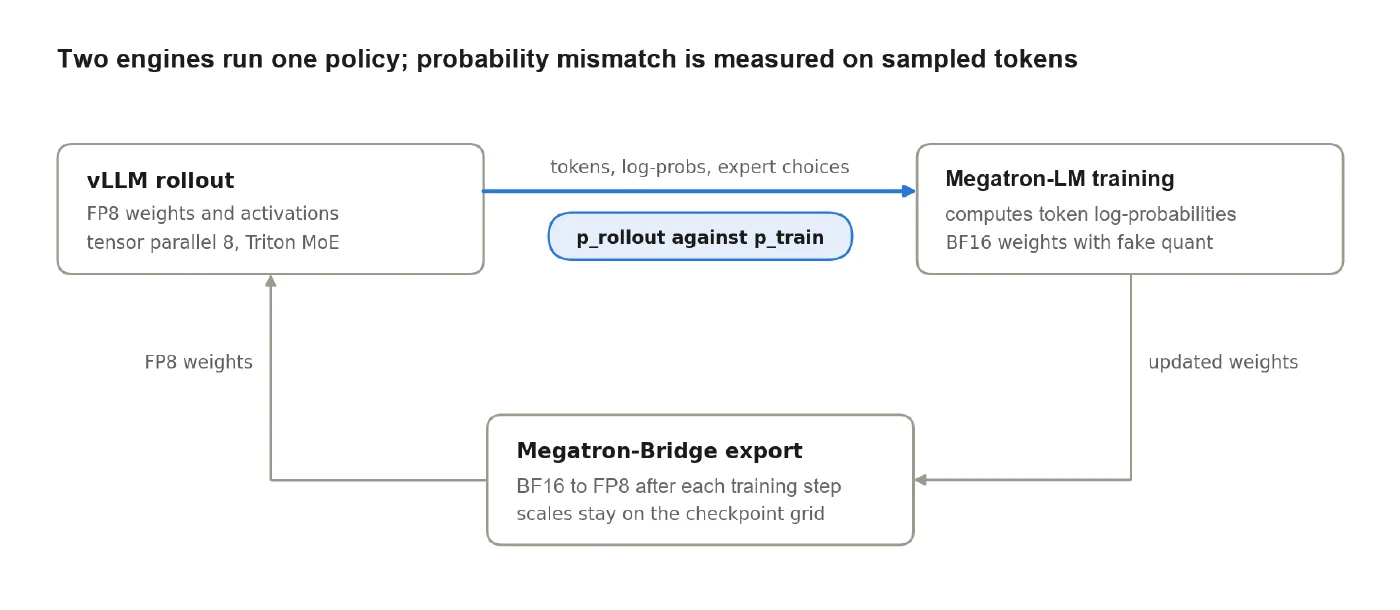
DeepSeek-V4-Flash has 284B parameters, with 13B active per token, 43 layers, and a context window of up to one million tokens. verl orchestrates the RL loop, Megatron-LM handles training, vLLM handles rollout generation, and Megatron-Bridge converts model weights between the training and rollout formats after each training step.
| Component | Configuration |
|---|---|
| Cluster | 4 nodes × 8 AMD Instinct MI355X GPUs (32 GPUs), ROCm 7.2.3 |
| Training | Megatron-LM with Transformer Engine; TP=1, PP=4, EP=8 (one pipeline stage per node, eight expert-parallel ranks per stage) |
| Rollout | vLLM, one engine per node with TP=8 and the Triton MoE backend |
| Weight sync | Megatron-Bridge converts the updated weights to the rollout format after each step |
| Memory | Training and rollout share the GPUs; the optimizer runs on the CPU with its states in host memory, parameters are offloaded to CPU memory during rollout, and vLLM’s KV cache is released during training |
| Algorithm | GRPO with a GSPO loss and router replay |
| Data | DAPO-Math prompts for training, AIME-2024 for validation |
| Batch | 64 prompts × 8 samples per step, up to 8,192 response tokens |
| Learning rate | 1e-6 |
| Rollout correction | Token-level truncated importance sampling, capped at 2 (BF16+QAT and FP8 runs only) |
Truncated importance sampling weights each token’s loss by the ratio of its training to rollout probability, capped at 2, to correct for the remaining mismatch between the two engines. The recipe script contains the full configuration; software versions are listed in the test-environment appendix .
Matching training to FP8 rollout
In RL, vLLM generates responses and Megatron-LM computes probabilities for the same tokens during training. These probabilities should agree closely: a mismatch biases the RL update, or, with our token-level correction, changes the weights applied to a response’s tokens. Our goal is to make training reproduce the numerical behavior of FP8 rollout.
On ROCm, the two engines quantize FP8 activations differently by default: vLLM uses a floating-point scale for each 1×128 group (amax / 448), while Transformer Engine’s blockwise recipe, on ROCm as well, rounds that scale up to a power of two, the same convention as DeepGEMM’s UE8M0 scales on NVIDIA GPUs. Weight scales are powers of two on both sides, as stored in the checkpoint. In the RL loop, training must quantize the same way as rollout, so training uses floating-point scales for activations and power-of-two scales for weights.
Training also reproduces the rollout’s KV-cache and indexer quantization. The indexer matters because DeepSeek-V4-Flash’s sparse-attention layers use it to select a subset of compressed KV entries for each query, and FP8 rounding can change which entries it selects. Router replay makes training reuse the expert choices made during rollout.
We also changed Megatron-Bridge’s export so that, when updated weights are re-quantized to FP8 for vLLM, the new scales are rounded up to powers of two on the checkpoint’s scale layout, keeping its power-of-two (ue8m0) scale format. Before this change, the export recomputed scales as plain amax / 448, so an unchanged weight came back with about 2.6% RMS error and vLLM ran a slightly different model after every weight sync; now an unchanged weight round-trips exactly. Together, these changes keep the quantization rules consistent through training and weight synchronization.
This alignment supports two training recipes with FP8 rollout. BF16+QAT trains in BF16 arithmetic with forward-pass FP8 rounding that reproduces the FP8 rollout; gradients pass through the rounding operations. FP8 trains with Transformer Engine’s FP8 recipe and matching activation scales. Our BF16 baseline uses BF16 training and BF16 rollout, while retaining FP8 KV-cache and indexer quantization.
We check the resulting agreement on the tokens generated at the first training
step. The mean absolute probability difference
(training/rollout_probs_diff_mean) measures the gap between their token
probabilities; training–rollout KL (rollout_corr/kl) is the k1 estimate of
KL(π_rollout ‖ π_train): the mean over response tokens of log π_rollout − log
π_train. Figure 2 shows the remaining mismatch for each recipe. These are
numerical checks; AIME accuracy measures task performance.
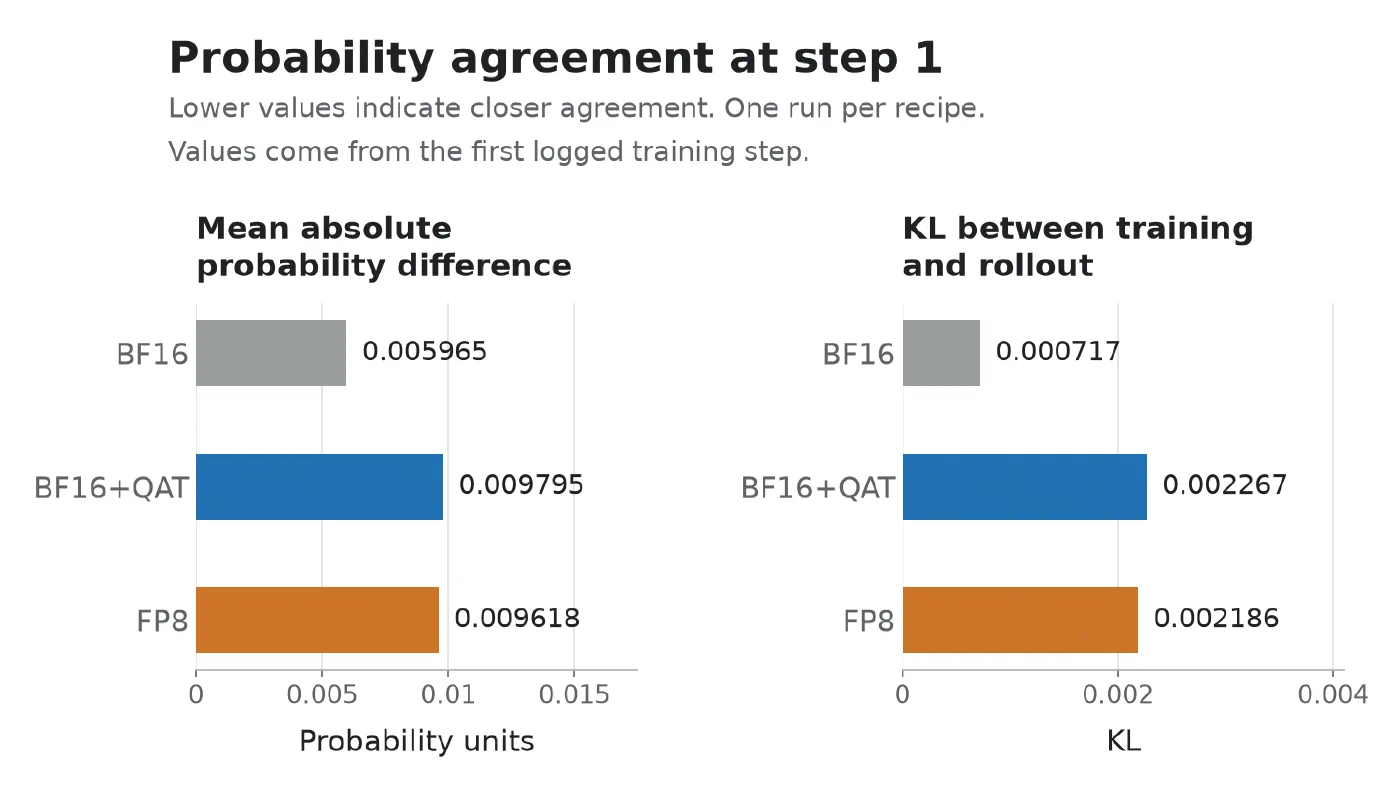
At step 1, BF16+QAT and FP8 had mean absolute probability differences of 0.0096–0.0098 and KL values of 0.0022–0.0023. BF16 remained lower at 0.0060 and 0.00072, respectively. Different kernel arithmetic can still produce differences that FP8 rounding amplifies, so the two engines are not bit-identical. We next examine whether numerical agreement is maintained during 300 training steps, how task accuracy evolves, and what each recipe costs.
Training results over 300 steps
We next followed the three recipes through 300 training steps and evaluated AIME-2024 every 10 steps, sampling one response per record with temperature 1.0 and top-p 0.7. Because validation is sampled rather than greedy, each evaluation carries sampling noise. All three runs used the configuration in the table above and seed 42, with one run per recipe.
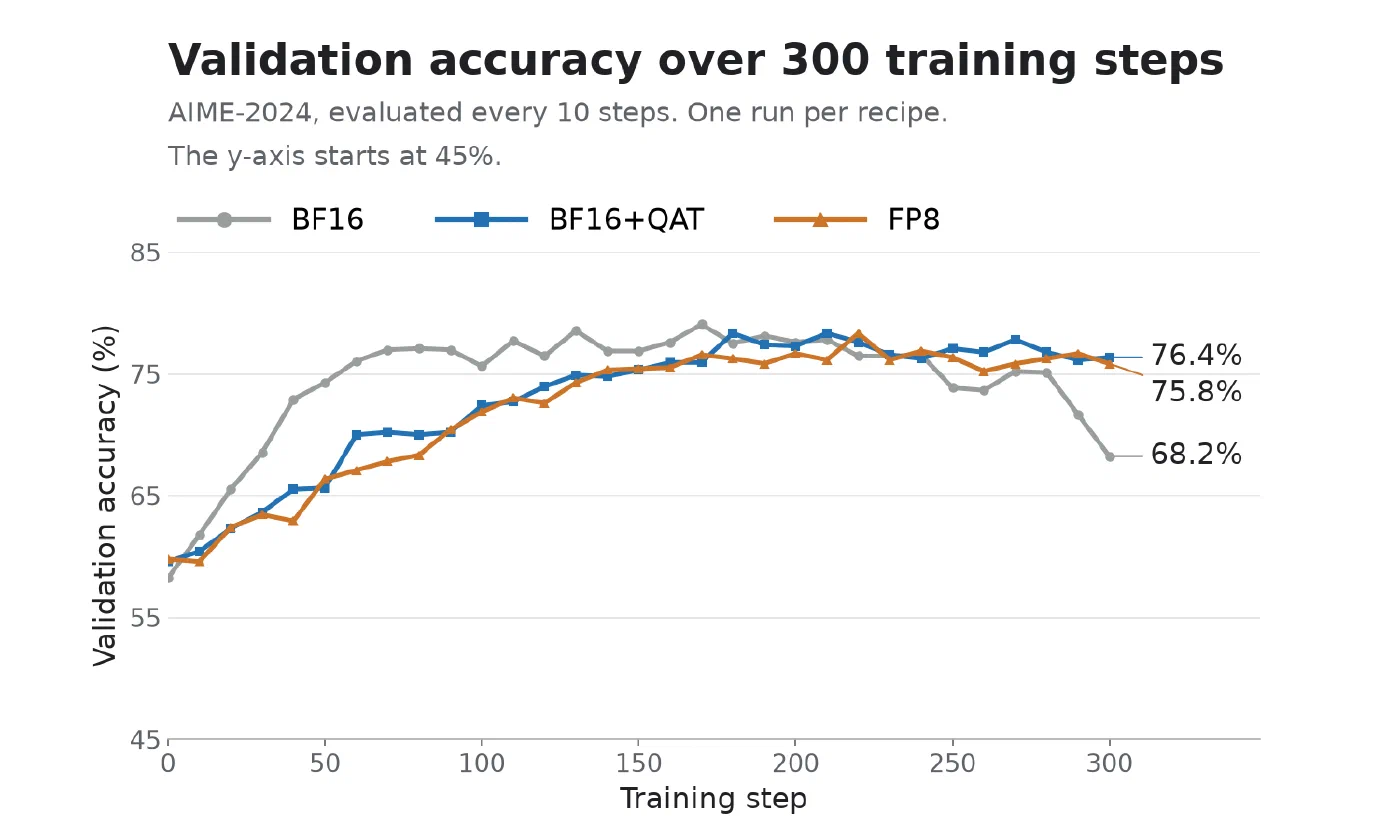
Both FP8-rollout recipes improved from about 60% accuracy to about 76%. BF16+QAT finished at 76.4%, and FP8 at 75.8%. BF16 improved faster early in training, peaked at 79.1% near step 170, and finished at 68.2%. The curves show useful learning with FP8 rollout, while also showing that the highest intermediate score and the final score can differ.
BF16+QAT and FP8 improved more gradually. One possible explanation is that rounding changes how small weight updates affect the rollout model: some updates stay within an FP8 rounding interval, while others cross into a new value.
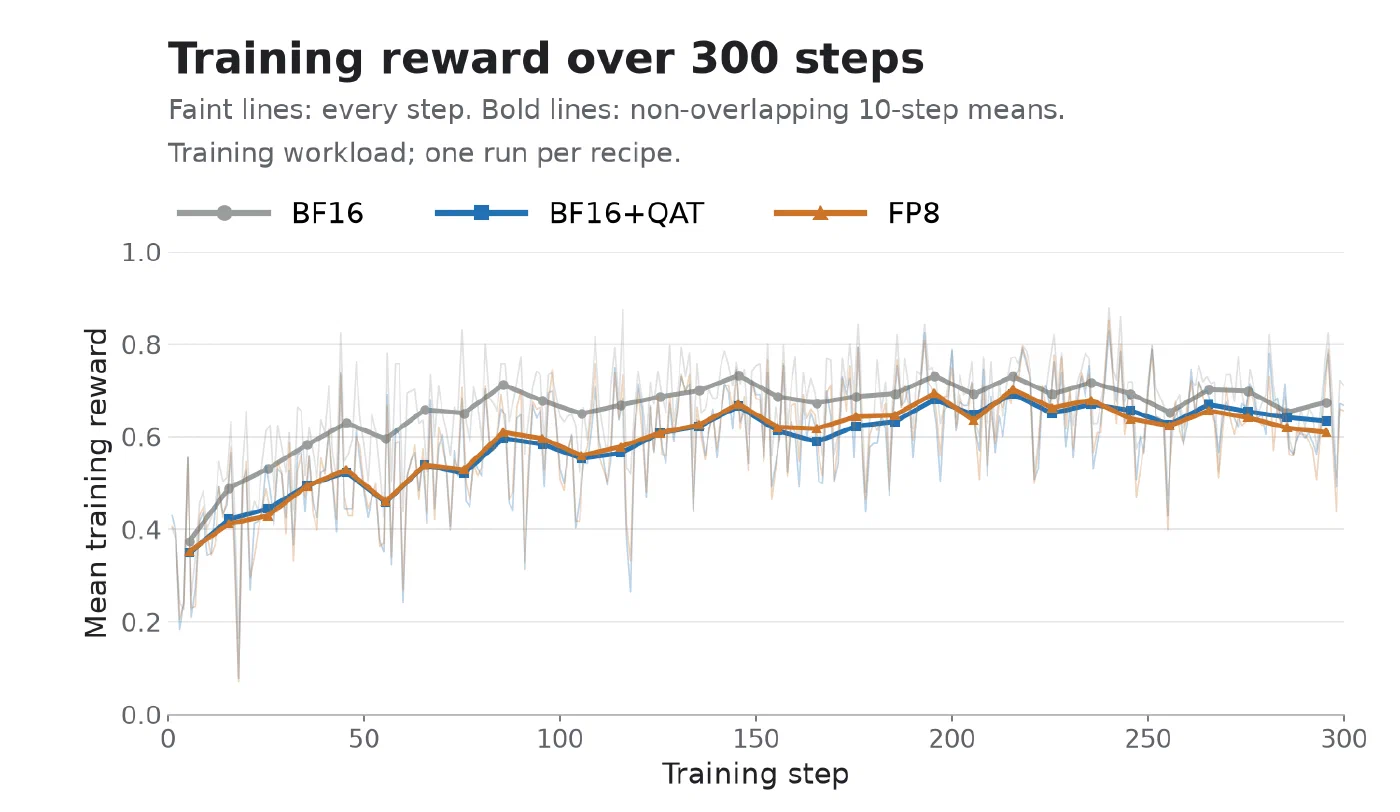
Mean training reward also increased in all three runs. Comparing the first and last 50 steps, it rose from 0.522 to 0.677 for BF16, 0.447 to 0.646 for BF16+QAT, and 0.444 to 0.630 for FP8 (Figure 4). These are averages over time within each run.
Why did BF16 lose accuracy late in training? After about step 150, its training reward stayed roughly flat, but its policy entropy kept rising, from an average of 0.14 over steps 101–150 to 0.35 over steps 251–300: the model became less certain about which token to generate next. Entropy stayed flat or fell in the other two runs over the same steps. Validation samples at temperature 1.0, so a less certain model more often samples a wrong step and solves fewer AIME problems.
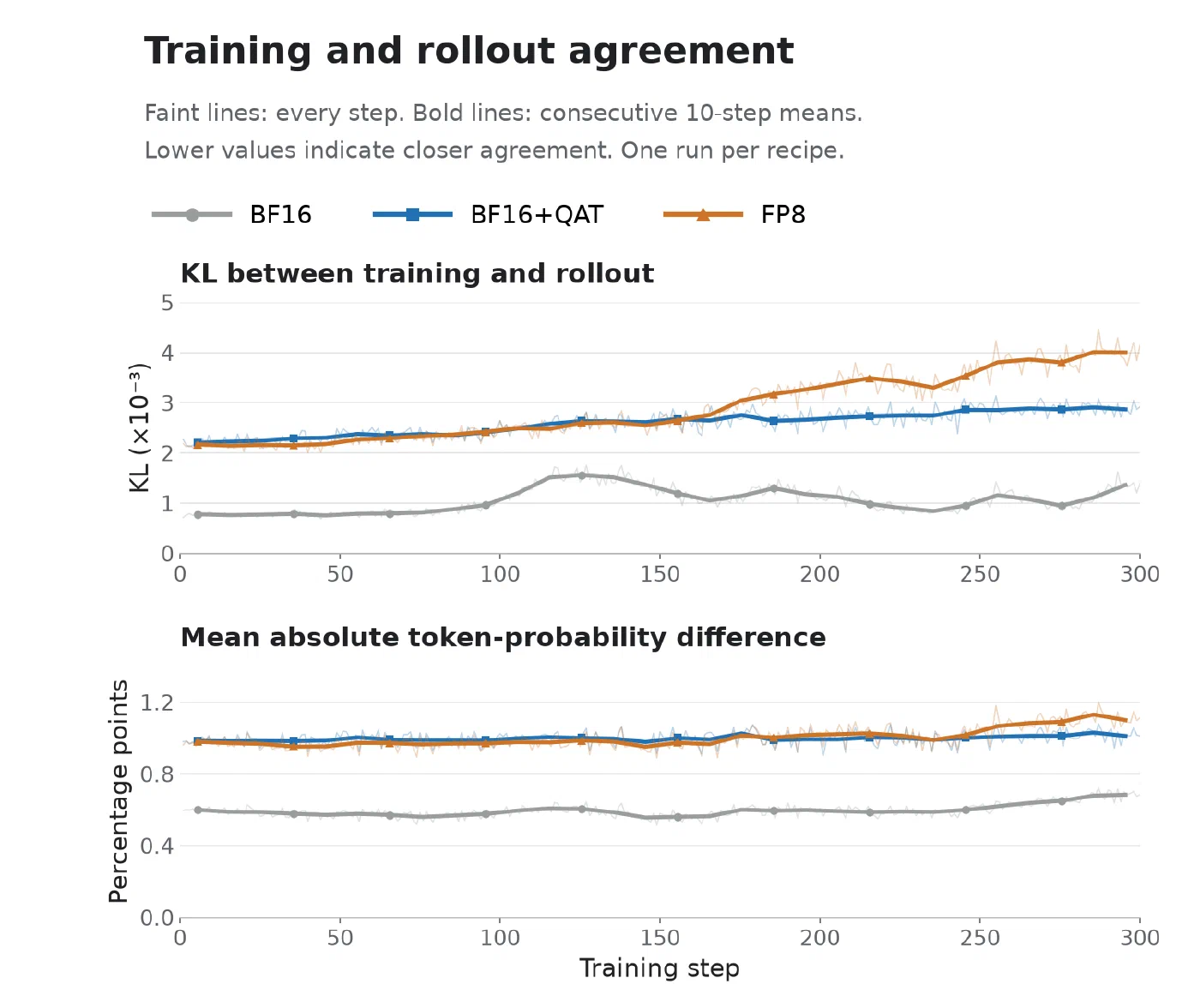
BF16+QAT kept closer agreement with rollout than FP8 late in training. Over the first 50 steps, mean KL was 0.00225 for BF16+QAT and 0.00216 for FP8. Over the last 50 steps, it was 0.0029 for BF16+QAT and 0.0039 for FP8. BF16 stayed lower, moving from 0.00077 to 0.00113. This measures agreement between engines; the AIME curve separately measures performance on the task.
The FP8-rollout recipes took longer per step than BF16, mainly because FP8 weight synchronization re-quantizes the updated weights and QAT adds rounding operations during training; generation time was similar across the three recipes because each step waits for its longest response.
For an FP8 deployment target, BF16+QAT is a useful starting point when numerical agreement is the priority. It had less late-run KL drift than FP8, at a higher cost per step in these runs. BF16 was the fastest per step and had the lowest mismatch, but its checkpoint is about twice the size; converting its result to FP8 for deployment needs separate validation.
Reproduce
PR #8146 is merged into verl main. Start from a checkout of verl-project/verl main and use the Docker build arguments below so the image also installs that upstream branch. The test-environment appendix records the historical branch used for the reported runs.
| What | Where |
|---|---|
| verl | verl-project/verl , main (merged PR #8146 ): the Dockerfile (which pins the Megatron-LM and Megatron-Bridge branches), the vLLM patches, and the recipe |
| Megatron-LM | PeterYang12/Megatron-LM
, branch deepseek-v4-rocm-support |
| Megatron-Bridge | PeterYang12/Megatron-Bridge
, branch deepseek-v4-rocm-support |
| Image | docker/rocm/Dockerfile.rocm.deepseek-v4 on verl main; use VERL_REPO=https://github.com/verl-project/verl.git and VERL_BRANCH=main when building |
FP8 checkpoint (qat, fp8) | PeterYang12/DeepSeek-V4-Flash-FP8-vllm |
BF16 checkpoint (TRAIN_MODE=bf16) | PeterYang12/DeepSeek-V4-Flash-bf16-vllm |
| Settings and reference values | the header of examples/grpo_trainer/run_deepseek_v4_flash_megatron_rocm.sh |
# 1. image
DOCKER_BUILDKIT=1 docker build --build-arg VERL_REPO=https://github.com/verl-project/verl.git --build-arg VERL_BRANCH=main -f docker/rocm/Dockerfile.rocm.deepseek-v4 -t rocm-verl-dsv4 .
# 2. Ray inside the container on every node (head first)
ray start --head --node-ip-address=<node ip> --port=6380 --num-gpus=8     # head
ray start --address=<head ip>:6380 --node-ip-address=<node ip> --num-gpus=8   # workers
# 3. training, inside the head container
WK=<wandb key> TRAIN_MODE=qat bash examples/grpo_trainer/run_deepseek_v4_flash_megatron_rocm.sh   # or fp8, bf16
The reported FP8-rollout runs started near 0.002 for rollout_corr/kl and 0.01
for rollout_probs_diff_mean. The recipe enables truncated importance sampling
in every mode; the BF16 run reported here had it off, which corresponds to
ROLLOUT_IS=null.
Upstream support and next steps
This work builds on the DeepSeek-V4 support already upstream in verl, including ROCm enablement, router replay, and weight-refit fixes. The recipe and Dockerfile are now merged in PR #8146 .
Next, we plan to:
- Support DeepSeek-V4.1-Flash .
- Optimize performance and kernels for low-precision training such as QAT and FP8, including FP8 weight synchronization and fake-quantization overhead.
- Use batch-invariant kernels in training and rollout, a step toward bitwise-identical log-probabilities between the two engines.
- Explore more training modes, such as fully asynchronous training.
- Upstream the remaining quantization-alignment changes.
Appendix: test environment
| Item | Details |
|---|---|
| Nodes | 4 × 8 AMD Instinct MI355X (gfx950, 288 GB HBM), 2 AMD EPYC 9575F CPUs and 3 TB host memory per node; 8 RDMA NICs per node (RoCE v2) |
| Software | Linux 5.15, ROCm 7.2.3, RCCL 2.27.7, PyTorch 2.11.0, Triton 3.6.0, Ray 2.58.0; base image vllm/vllm-openai-rocm:v0.26.0 |
| Transformer Engine | 2.18.0.dev0 (ROCm build) |
| Megatron-LM | fd1121b8f (megatron-core 0.19.0), branch deepseek-v4-rocm-support |
| Megatron-Bridge | 0.5.0 plus the power-of-two export fix, branch deepseek-v4-rocm-support |
| vLLM | 0.26.0 (ROCm build); AITER 0.1.16.post3 |
| verl | Historical test revision: PeterYang12/verl, branch dsv4-rocm. Current reproduction instructions use verl-project/verl main after PR #8146. |
| Data | DAPO-Math-17k training prompts. AIME-2024 validation at step 0 and every 10 steps, with 960 records in each evaluation, one sampled response per record (temperature 1.0, top-p 0.7). |
| Reported numbers | All metrics are from the recorded W&B runs. Early and late averages use steps 1–50 and 251–300 unless stated otherwise. Accuracy is val-core/math_dapo/acc/mean@1, recorded at step 0 and every 10 steps. |
Related work
- Bringing DeepSeek-V4 Flash RL Training to AMD Instinct MI355X GPUs with Miles , AMD and Miles team, July 2026. The same model and hardware with SGLang rollout.
- Enabling DeepSeek-V4-Flash Training on AMD Instinct MI355X GPUs with Primus , AMD, September 2026. Pretraining performance on the same GPUs.
- FP8 Quantization in NeMo RL , NVIDIA. DeepSeek-style block-scaled FP8 for generation and training, with importance sampling recommended to handle the training–inference mismatch.
- VeOmni pull request 1089 , DeepSeek-V4 QAT on NVIDIA GPUs. It uses power-of-two activation scales, following DeepSeek-V4’s E8M0 scale convention, where we use float scales to match vLLM on ROCm.
- DeepSeek-V4: Towards Highly Efficient Million-Token Context Intelligence , DeepSeek-AI, April 2026. Section 3.3 describes the batch-invariant and deterministic kernels, and Section 5.2.1 the FP4 quantization-aware training used in DeepSeek’s own post-training.
- No More Train-Inference Mismatch: Bitwise Consistent On-Policy Reinforcement Learning with vLLM and TorchTitan , vLLM and TorchTitan teams, November 2025. Bitwise-identical log-probabilities between rollout and training.