Bringing End-to-End LLM Reinforcement Learning to AMD Instinct MI455X with verl
A complete GRPO workflow using verl, Qwen3-30B-A3B, SGLang, and PyTorch FSDP ran for 100 consecutive steps on four AMD Instinct MI455X GPUs, establishing an end-to-end RL baseline for CDNA 5.
AMD Instinct™ MI455X is the first accelerator based on the fifth-generation AMD CDNA™ architecture. Bringing up a new GPU generation, however, goes beyond hardware enablement: real-world AI workloads depend on the entire software stack—from frameworks and optimized kernels to communication libraries—working together reliably and efficiently end to end.
In this post, we walk through the enablement of an end-to-end Group Relative Policy Optimization (GRPO) workflow on MI455X, integrating verl , Qwen3-30B-A3B, SGLang, and PyTorch FSDP. Our goal is to validate the complete reinforcement learning loop—including rollout generation, policy training, and weight synchronization—on the new CDNA 5 platform, and to identify and resolve the cross-stack challenges required to make the workflow run reliably.
Result at a glance
- End-to-end execution: 100 consecutive GRPO steps completed on four MI455X GPUs.
- Full workflow: every step covered rollout generation, actor-side probability computation and optimization, weight synchronization, and transition into the next rollout.
- Numerical consistency: rollout-to-actor sampled-token probability
correlation was approximately
0.9965, with no visible drift. - Runtime stability: the final configuration had no out-of-memory error, kernel fault, or collective timeout, and peak allocated memory remained flat after warm-up.
AMD Instinct MI455X: bringing RL to CDNA 5
AMD launched the Instinct MI400 Series at Advancing AI 2026. MI455X is the first Instinct accelerator based on AMD CDNA 5 and sits at the center of the 72-GPU AMD Helios™ rack-scale system.12
| Specification | AMD Instinct MI355X | AMD Instinct MI455X |
|---|---|---|
| Architecture | AMD CDNA 4 | AMD CDNA 5 |
| High-bandwidth memory | 288 GB HBM3E | 432 GB HBM4 |
| Peak memory bandwidth | 8 TB/s | Up to 23.3 TB/s |
Table 1. Public specifications for MI355X and MI455X. Sources: 23
Compared with MI355X, MI455X increases per-GPU HBM capacity by 50% and peak memory bandwidth by about 2.9×. At the package level, eight 3D hybrid-bonded CDNA 5 compute chiplets are paired with two fabric-and-cache dies, 192 MB of global L2 cache, and 12 HBM4 stacks. CDNA 5 also changes the execution and data-movement model exposed to software. MI455X provides 256 Work Group Processors (WGPs) with Wave32 execution. A Tensor Data Mover supports asynchronous global-memory-to-LDS transfers without register staging, while L2 multicast and WGP clustering reduce redundant traffic and coordination overhead.
For end-to-end RL, memory capacity is only part of the story. Model states,
training activations, rollout KV caches, and updated weights must flow
efficiently across kernels, process groups, and framework boundaries. On a new
gfx1250 platform, each of these paths must be enabled and validated as part of
a complete system.
The end-to-end RL loop therefore provides a practical test of software readiness on MI455X. It exercises the full workflow—from SGLang rollout generation and PyTorch FSDP actor training to weight synchronization between the rollout and training engines—exposing integration and performance challenges that may not surface when individual components are tested in isolation.
What the end-to-end RL loop exercises
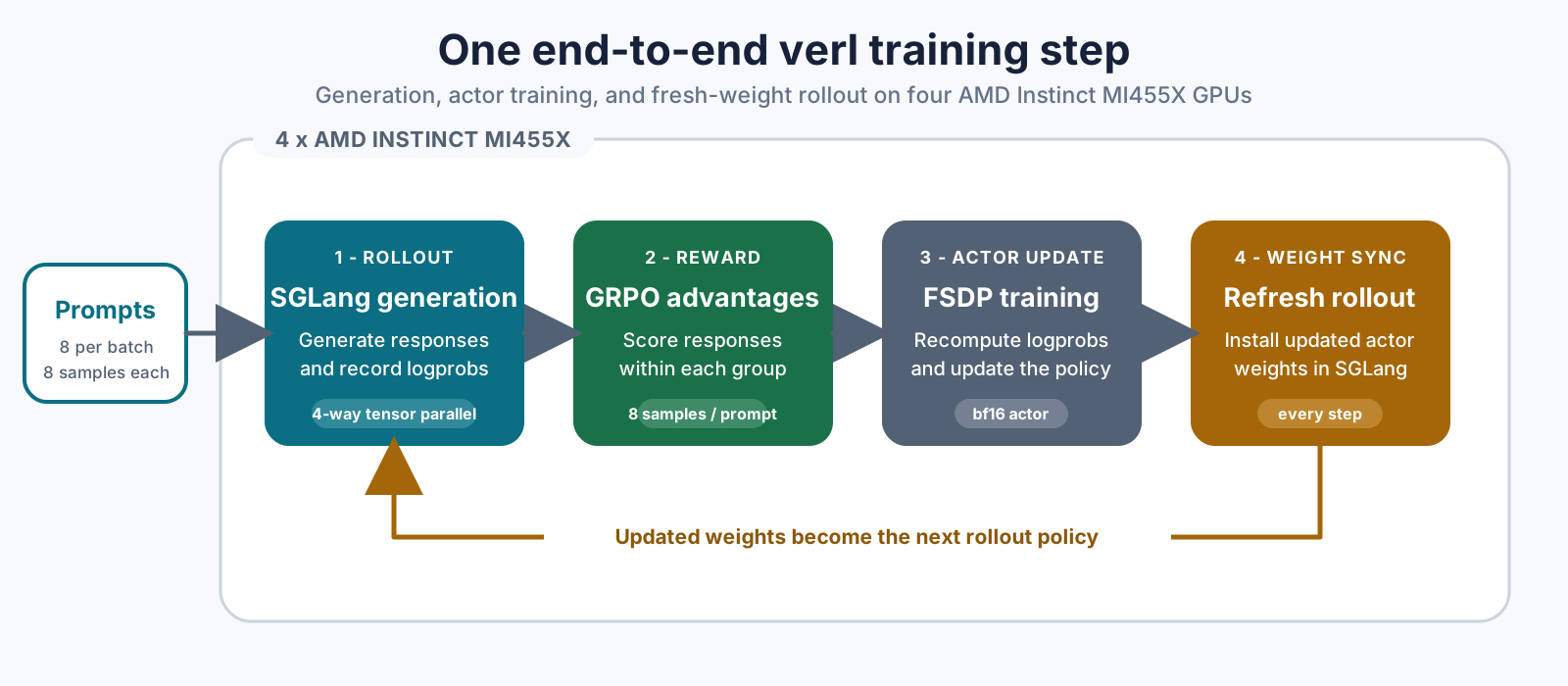
One training step crosses two execution stacks. SGLang uses tensor parallelism to generate multiple responses per prompt and returns sampled-token log probabilities. verl scores the responses and computes GRPO group-relative advantages;45 PyTorch FSDP then recomputes actor probabilities and applies the sharded update. Before the next rollout, the updated weights are broadcast back into the SGLang schedulers. This tests two boundaries that isolated inference or training does not: numerical agreement between the rollout and actor paths, and model-state transfer across their process groups.
What it took to run on MI455X
Enabling the full verl workflow on MI455X required work across rollout kernels, actor training, checkpoint loading, and weight synchronization.
Rollout: route kernels per operation
SGLang required selecting kernel paths per operation on gfx1250. AITER provided
MoE top-k routing, while Triton handled attention and expert GEMMs, enabling
stable generation and CUDA graph execution.
Actor: enable the CDNA 5 training stack
We enabled the actor stack for gfx1250 by building Transformer Engine and Apex
with CDNA 5 targets, then selecting PyTorch SDPA for attention and Triton for
grouped GEMM. This configuration provided the BF16 execution path required for
stable FSDP actor training.
Checkpoint loading: reduce host-memory pressure
Checkpoint loading initially materialized the model in FP32, causing excessive host-memory usage. Loading directly in BF16 substantially reduced memory pressure and enabled reliable initialization.
Weight synchronization: complete the RL loop
Actor-to-rollout weight synchronization required two adjustments: selecting the RCCL path by disabling MSCCL/MSCCL++, and adapting verl to SGLang’s new session-based weight-update API. With these changes, updated actor weights synchronized reliably after every training step, completing the end-to-end GRPO loop.
Reproducing the MI455X run
Workload configuration
- Hardware: 4 × AMD Instinct MI455X (
gfx1250), 432 GB HBM4 per GPU, single node, driver7.1.1.31300009 - Model / data: Qwen3-30B-A3B, a 128-expert MoE model,6 on DAPO-Math-17k7
- Algorithm: GRPO, learning rate
1e-6, 8 prompts × 8 responses per step, 8,192-token maximum response - Engines: SGLang 0.5.19 rollout at TP=4; PyTorch FSDP actor across the same four GPUs
- Software: ROCm 10.0.0, PyTorch 2.11.0+rocm10.0.0, Transformer Engine 2.17.0, Megatron-LM 0.19, verl 0.10.0.dev
- Run: 100 training steps, 8.0 hours wall clock
Launch command
The image carries the gfx1250 environment and both compatibility patches; the
Dockerfile, launch script, and patches are published in full.8
docker pull amdagi/verl-dev:verl-rocm10-mi45x

docker run --rm --device=/dev/kfd --device=/dev/dri --group-add video \
  --security-opt seccomp=unconfined --ipc=host --shm-size=64g \
  --ulimit memlock=-1 --ulimit stack=67108864 \
  -e NCCL_IB_DISABLE=1 \
  -v $MODELS:/root/models -v $DATA:/root/datasets \
  amdagi/verl-dev:verl-rocm10-mi45x \
  bash examples/grpo_trainer/run_qwen3_30b_a3b_mi45x.sh
MI455X-specific image configuration
These are compatibility settings, not tuning:
- Rollout:
SGLANG_USE_AITER=1,SGLANG_ATTENTION_BACKEND=triton, andmoe_runner_backend=triton. - Training:
NVTE_USE_GROUPED_GEMM_TRITON=1,model_dtype=bf16,attn_implementation=sdpa, andENABLE_CK=0. - Collectives and memory: set
RCCL_MSCCL_ENABLE=0,RCCL_MSCCLPP_ENABLE=0,TORCH_NCCL_USE_TENSOR_REGISTER_ALLOCATOR_HOOK=0,GPU_MAX_HW_QUEUES=2, andPYTORCH_ALLOC_CONF=expandable_segments:True; clearNCCL_MIN_NCHANNELS.
NCCL_IB_DISABLE=1 is supplied only at run time for this single-node job.
Validation results
Rollout-to-actor probability consistency
Rollout generation and actor training evaluate the same sampled tokens through different execution paths. To verify that the two paths remained numerically aligned, we compared their sampled-token probabilities at every training step.
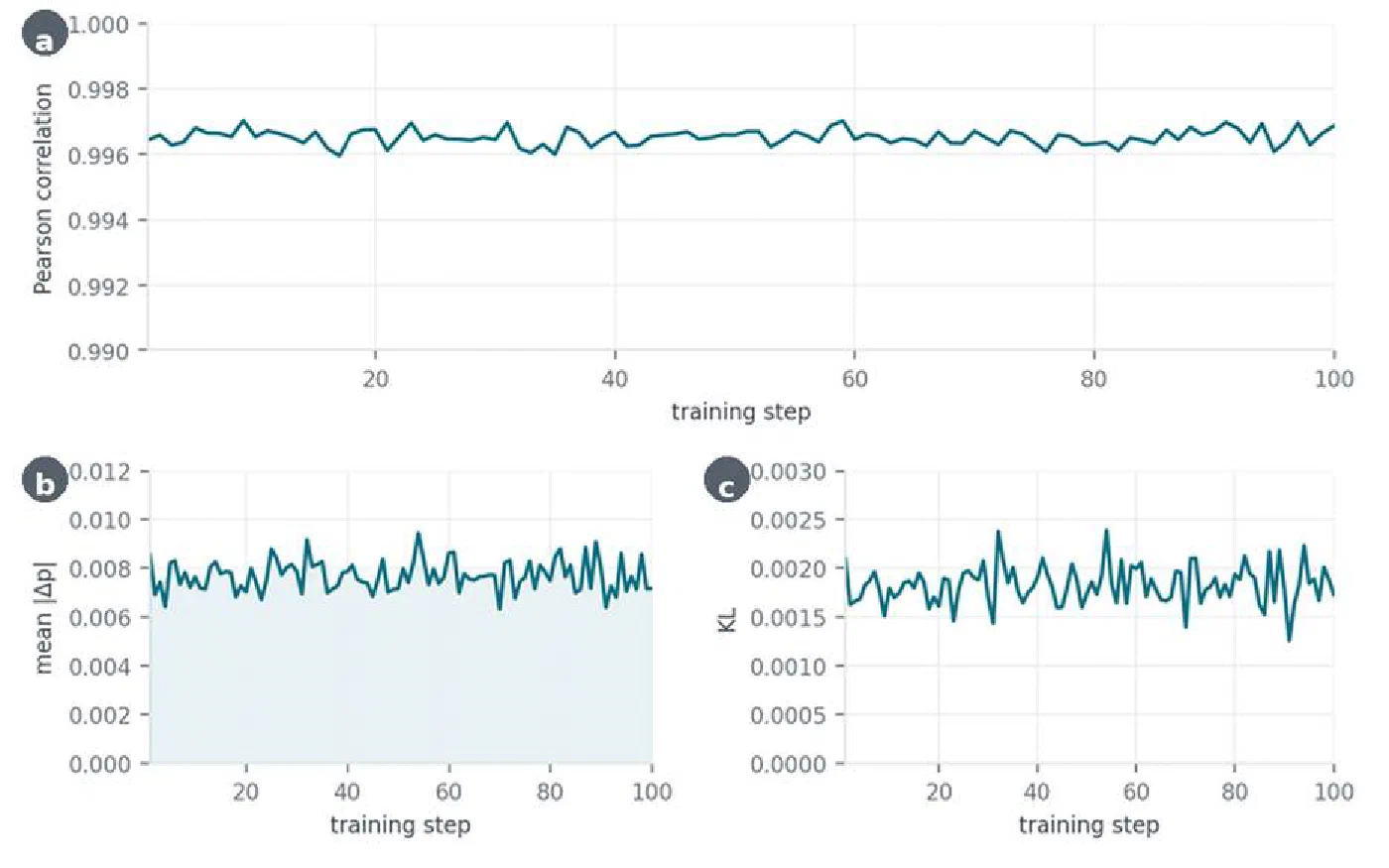
0.9965 (σ 0.0003), (b) mean absolute sampled-token probability difference, mean 0.0077 over a 0.0063–0.0094 range, and (c) sampled forward KL, mean 0.00183.Across 100 steps, all three metrics remained within a narrow range with no visible drift, indicating stable numerical agreement between the rollout and actor paths. These measurements provide a sampled-token consistency baseline for tracking future kernel and framework changes.
Training stability
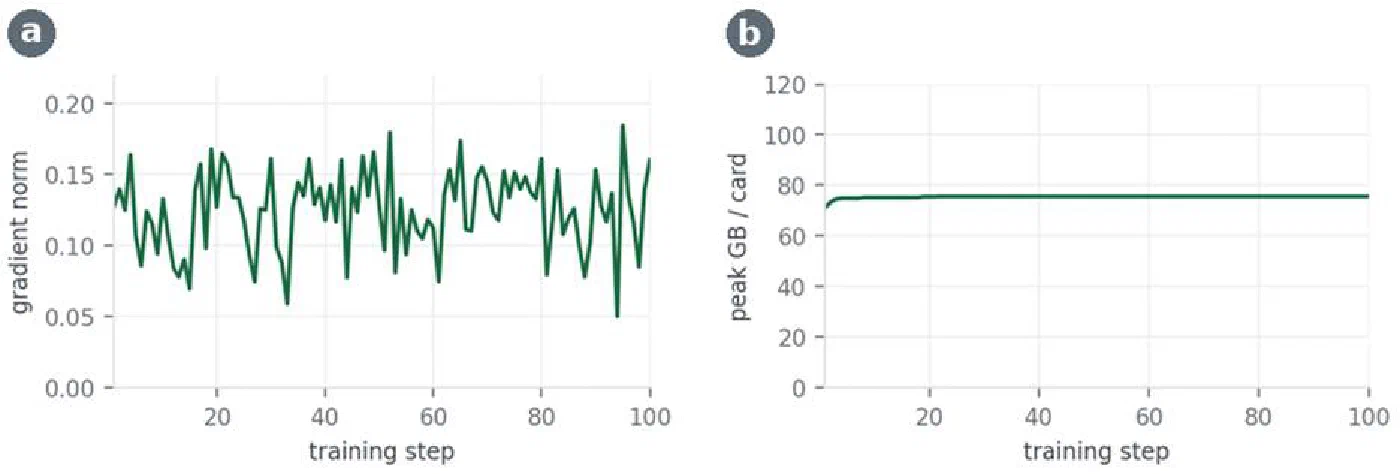
0.124, and (b) peak allocated memory per card, flat at 75.6 GB from step 11 onward.The gradient norm remained bounded throughout the run, while peak allocated
memory stabilized at 75.6 GB per GPU from step 11 onward.
Where a step spends its time
| Phase | Share of step wall clock |
|---|---|
| Rollout generation | 48.1% |
| Actor update | 39.1% |
| Log-probability pass | 10.9% |
| Weight synchronization | 1.8% |
Table 2. Share of step wall clock by phase, averaged over 100 steps.
Conclusion
This work marks the first end-to-end enablement of verl on AMD Instinct™ MI455X, demonstrating a complete GRPO workflow on the new CDNA 5 platform. A 30B-class MoE model can generate rollouts with SGLang, train with PyTorch FSDP, and synchronize updated weights every step, with stable sampled-token diagnostics across 100 updates.
This milestone establishes a functional RL baseline on MI455X rather than a claim about peak performance or scaling. It provides a foundation for broader model coverage, longer runs, multi-node scaling, and continued performance optimization on CDNA 5.
References
AMD Newsroom, “AAI 2026: AMD Launches AMD Instinct MI400 Series GPUs for Frontier AI, HPC ,” 2026. ↩︎
AMD, “AMD CDNA™ Architecture .” ↩︎ ↩︎
AMD, “AMD Instinct™ MI355X GPUs .” ↩︎
G. Sheng et al., “HybridFlow: A Flexible and Efficient RLHF Framework ,” EuroSys ‘25, 2025. ↩︎
Z. Shao et al., “DeepSeekMath: Pushing the Limits of Mathematical Reasoning in Large Language Models ,” arXiv:2402.03300, 2024. ↩︎
A. Yang et al., “Qwen3 Technical Report ,” arXiv:2505.09388, 2025. ↩︎
Q. Yu et al., “DAPO: An Open-Source LLM Reinforcement Learning System at Scale ,” arXiv:2503.14476, 2025. ↩︎
“MI455X verl bring-up source: Dockerfile, launch scripts, and compatibility patches ,” commit
d743237. ↩︎