Introducing verl-tinker: Your Tinker loop, your GPUs
Keep the Tinker Cookbook loop you know, and run SFT, RL, and distillation on verl-managed GPU workers you control.
What if you could keep a Tinker Cookbook training loop exactly where it is, but run the heavy lifting on your own GPUs?
That is what verl-tinker makes possible. The official Tinker SDK and nearly
the full range of Tinker Cookbook recipes work as they are; in most cases, the
only client-side change is overriding the base URL. Point the program at a
local HTTP endpoint and it can drive supervised fine tuning (SFT),
reinforcement learning (RL), online and offline distillation, checkpointing,
and rollout on verl-managed workers.
In other words: the experiment loop stays simple; the infrastructure becomes yours.
The implementation is available now in the
verl_tinker recipe
.
It is deliberately lightweight: a thin forwarding layer exposes a
Tinker-compatible API, while presets make it easy to launch the server in one
step. Underneath, workloads run on mature, production-tested verl, VeOmni, and
vLLM configurations.
Keep the loop. Bring the infrastructure.
Tinker Cookbook recipes describe an algorithm from the researcher’s point of view. They build data, ask a model to sample or compute log probabilities, submit a loss-bearing batch, and take an optimizer step. It is an appealingly compact way to express an experiment.
verl tackles the other side of the problem: distributed actor, reference, rollout, and teacher workers; model-state movement; parallelism; offload; and checkpoint storage.
verl-tinker joins those two worlds at the API boundary. Researchers keep the
concise Cookbook loop and choose the cluster, model weights, inference engine,
parallelism strategy, and storage behind it. The client environment needs only
tinker and tinker-cookbook; the server owns the distributed runtime.
The bridge stays intentionally small. It forwards Tinker operations into the backend and handles the compatibility details at the API boundary; it does not reimplement the training or inference stack. The distributed execution path comes from the same proven backend configurations used by verl, VeOmni, and vLLM workloads.
Start a workload in minutes
Install the server environment from the root of verl-recipe, then start an
actor-and-rollout configuration:
./install_verl.sh --recipe verl_tinker
cd verl_tinker
python -m verl_tinker.start \
  --config configs/quick_start/actor_rollout.yaml
Once GET /api/v1/healthz returns {"status":"ready"}, point a client at the
server:
export TINKER_BASE_URL=http://127.0.0.1:8000/
export TINKER_API_KEY=tml-verl-tinker-local

cd verl_tinker/client_examples
uv sync
uv run run_single_test.py \
  --test-name sft_tulu3
That is the whole handoff. For an existing SDK or Cookbook workload, setting
TINKER_BASE_URL is usually all that is required. The recipe issues familiar
Tinker calls, and the server forwards them to the distributed backend.
The bundled client examples are intentionally lightweight wrappers around recipes from the Tinker Cookbook . Together they cover most official Cookbook recipe patterns, including SFT, supervised distillation, GSM8K RL, SFT followed by RL, and single- or multi-teacher on-policy distillation.
They are examples, not a required client layer. Because verl-tinker speaks
the Tinker API, you can point your own program built with the Tinker SDK at the
same endpoint and run your own data, training loop, and workflow.
Three quick-start configurations cover the common shapes:
actor.yamlfor SFT and optimizer-only workflows;actor_rollout.yamlwhen the client callsasample;actor_rollout_ref.yamlfor RL that requests reference log probabilities for KL penalties.
What happens after the HTTP call?
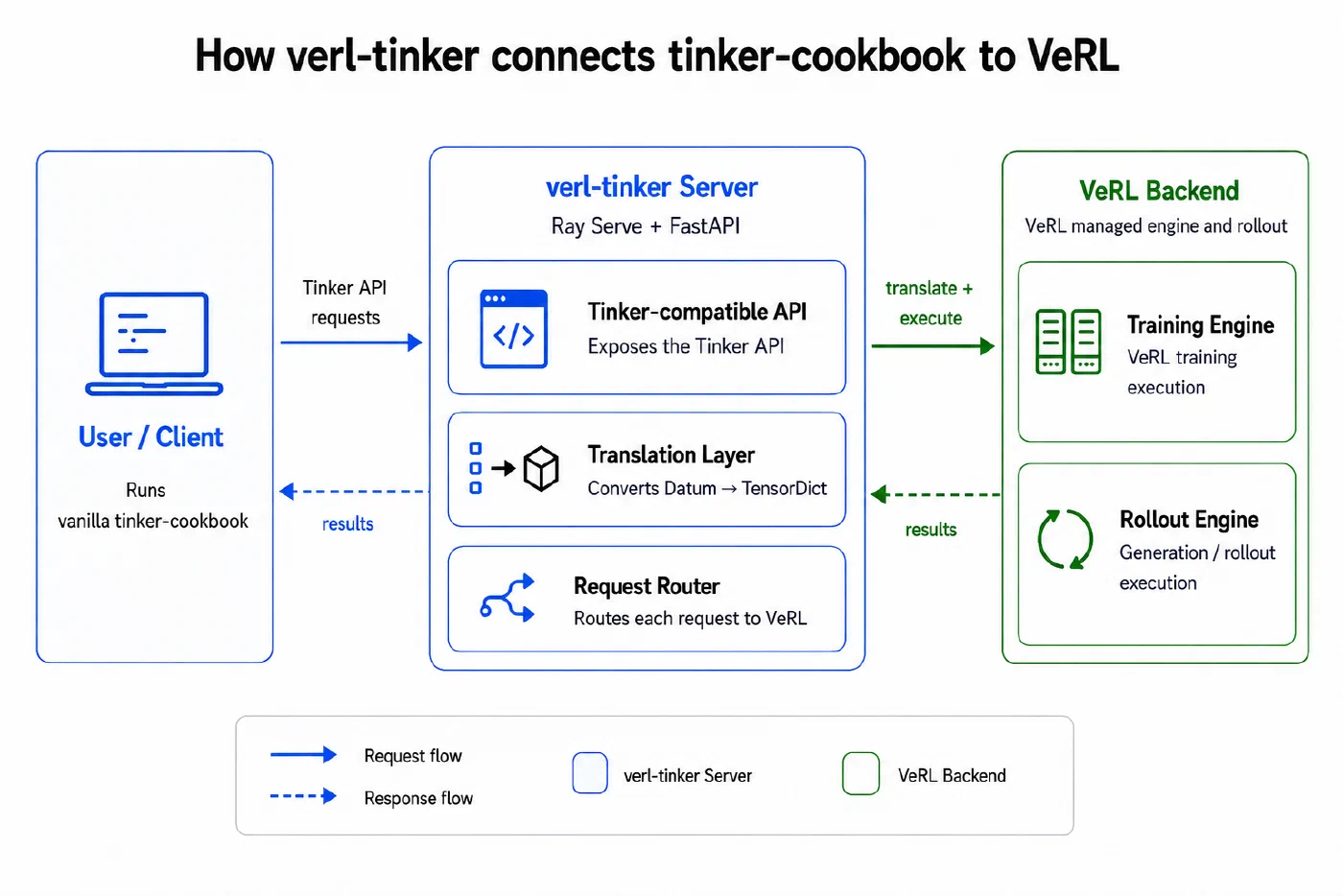
A request passes through three layers:
Tinker / Tinker Cookbook client
              |
              | Tinker-compatible HTTP
              v
Thin Tinker-compatible forwarding layer
              |
              | preset-backed server configuration
              v
verl / VeOmni training + vLLM rollout workers
Bring your teachers, too
Distillation is where this bridge gets especially interesting. A Tinker program can use one or more larger, frozen models as teachers, ask them to generate or return top-K log probabilities, and use those signals to train a smaller actor—all through the same familiar client API.
That means you can explore single-teacher or multi-teacher on-policy
distillation without building a separate serving stack for every model. Your
training loop decides how to use each teacher; verl-tinker runs the actor and
teachers on the GPU resources you assign to them.
The recipe includes two ready-to-adapt starting points:
- The single-teacher config pairs a Qwen3-1.7B actor with a Qwen3-30B-A3B teacher on eight GPUs.
- The multi-teacher config shows a Qwen3-8B actor learning from Qwen3-32B and Qwen3-235B-A22B teachers across two eight-GPU nodes.
Use these configs as templates: swap in your models, choose the parallelism that fits your cluster, and let your Tinker code decide what each teacher contributes to the learning signal.
Where the boundary is today
For most workflows, verl-tinker lines up closely with Tinker. The main
difference is that a server currently manages one trainable model and one
rollout replica.
Because that rollout is shared, a sampling session created from the trainable model is tied to a particular version of its weights. If the rollout is later synchronized to newer weights—or otherwise diverges from the version that session expects—the earlier sampling resource may no longer be available. Teacher sampling and reference-log-probability requests are separate and are not affected by this restriction.
You will not silently sample from the wrong weights. verl-tinker keeps track
of which model version each sampling resource belongs to and tells you when a
resource is no longer available.
Within that boundary, the division of labor stays simple: your Tinker code owns the experiment; verl owns distributed execution. You keep the loop you want, while choosing the GPUs, rollout engine, placement, offload, and checkpoints underneath it.
If that sounds like the missing bridge in your workflow, start with the
verl_tinker recipe
and run one of the included client examples.
verl-tinker was developed by the ByteDance AML/Seed Team.